RAG Architecture: A Complete Guide to Retrieval-Augmented Generation Architecture
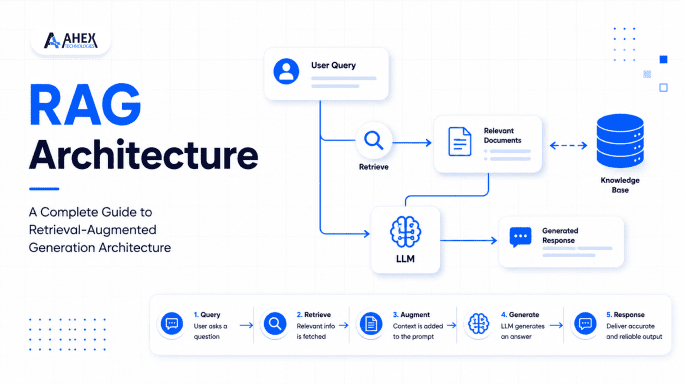
Retrieval-Augmented Generation is one of the most important architectural approaches in generative AI.
With it, LLMs are able to deliver accurate results by extracting relevant and up-to-date information from external sources.
The dependency on RAG is rising significantly. In 2024, the global retrieval-augmented generation market size was estimated at $ 1.2 billion. Now, experts project that it will reach $ 11.0 billion by 2030. The growth will be at a CAGR of 49.1%.

Source: Grand View Research
No doubt, LLMs are powerful, but they have some limitations. Hallucinations, outdated knowledge, and inability to access proprietary business data reduce the accuracy of large language models.
RAG systems overcome these challenges. These combine semantic retrieval with language generation. This allows AI systems to produce responses grounded in trusted information.
In this blog, learn about RAG architecture, how it works, and its core components. Also, we have given the security risks that you must avoid and the best practices for building reliable RAG systems.
What is RAG Architecture?
RAG architecture is an AI framework that enables LLMs to retrieve information from external knowledge sources.
LLMs not only rely on the data they are trained on for generating output, but they also extract the latest information via RAG systems from documents, databases, and knowledge bases. This makes the final results more accurate and up-to-date.
As of today, RAG architecture powers a wide range of generative AI applications, AI chatbots, smart assistants used for customer support, and internal knowledge management platforms.
Core Components of RAG Architecture
A RAG system architecture consists of multiple components. These work together to retrieve relevant information and generate accurate responses. Each one has a specific role. Read about each component and its role in ensuring the system delivers context-aware outputs.
1. Data Sources and Ingestion
Every RAG system begins with a knowledge source. Data can be collected from PDFs, documents, websites, databases, and internal knowledge bases, depending on the use case.
During the ingestion process, this data is extracted, cleaned, standardized, and indexed, ensuring it is ready for efficient retrieval.
2. Document Chunking and Embeddings
Large documents cannot be processed efficiently as a single unit. So, they are divided into smaller chunks. Each chunk is then converted into a vector embedding using an embedding model.
These embeddings capture the semantic meaning of the content, not just the keywords. This helps in information retrieval based on context and intent.
3. Vector Database
A vector database is where the embeddings generated are stored. It enables fast semantic search. It not only matches the keywords but also identifies content that matches conceptually with the users’ query.
Some popular vector databases are Pinecone, Milvus, and Weaviate. Each is designed to support high-performance similarity searches.
3. Retriever and Re-Ranker
The retriever searches the vector database to identify document chunks that are most relevant to the user’s query.
In advanced RAG architectures, a re-ranker further evaluates the retrieved results. Then, it rearranges them based on relevance.
This additional ranking step ensures that the LLM receives the most relevant information. It significantly enhances the response quality.
5. Large Language Model
The LLM is the reasoning engine of a RAG system. It combines the retrieved context with the user’s query to understand intent and generate coherent and natural-language responses.
In modern RAG architectures, GPT, Claude, and Llama are mostly used LLMs to produce responses grounded in retrieved information.
6. Response Generation
The final component combines the retrieved context and the LLM’s reasoning to generate a complete response.
The output might also include summaries, detailed explanations, and even citations, depending on the gen AI application.

RAG system architecture diagram
How Does RAG Architecture Work?
RAG architecture produces responses by combining information retrieval and text generation. It first searches for the relevant information from the external source and then provides that context to the LLM. This ensures a more factual and current response to the user’s query.
The entire process follows a structured RAG pipeline architecture. In this, each component plays a specific role in retrieving, processing, and generating reliable output. Let’s understand the working of the RAG pipeline.
Step-by-Step RAG Pipeline Architecture
The following steps explain how a typical RAG pipeline works:
1. Data Ingestion
Documents from PDFs, websites, databases, or enterprise repositories are collected. Then, they are prepared for processing.
2. Document Processing and Chunking
The collected data is cleaned. It is then split into smaller chunks and formatted. This improves retrieval accuracy and search performance.
3. Embedding Generation
Each document chunk is converted into a vector embedding using an embedding model. In this process, its semantic meaning is captured rather than just keywords.
4. Vector Database Storage
The generated embeddings are stored in a vector database. These can be searched here efficiently using semantic similarity.
5. User Query Processing
When a user asks a question, it is also converted into a vector embedding using the same embedding model.
6. Semantic Retrieval
The retriever compares the query embedding with the stored document embeddings. Then, it fetches the most relevant information.
7. Context Augmentation
The retrieved content is combined with the user’s query. It creates a comprehensive prompt for the LLM.
8. Response Generation
After that, the LLM analyzes both the query and the retrieved context. It generates an accurate, relevant, and natural-language response.
9. Response Delivery
The final output is presented to the user. Also, the LLM often provides citations or source references. This improves transparency and trust.
Why RAG Architecture Is Important for AI Applications
Modern AI apps should not only give responses fast, but those responses must be factual, context-aware, and based on the latest information.
When you train LLMs, the data is limited, and it becomes difficult for them to answer queries about recent events or organization-specific knowledge. This, thus, results in outdated results or hallucinated responses.
RAG architecture is important for AI apps because it addresses these limitations. LLMs are connected to external knowledge repositories in real time.
Instead of generating a response purely from memory, the model can first get information from databases and then use it as context to produce more accurate results.
Key Benefits of RAG Architecture
The top advantages of RAG architecture in AI applications are as follows:
- It gives access to real-time and frequently updated information
- RAG reduces hallucinations and improves factual accuracy
- It supports proprietary enterprise knowledge
- RAG architecture ensures better explainability through source-backed responses
- It is a cost-effective alternative to frequent model fine-tuning
- It is a scalable architecture for enterprise AI applications
Traditional LLMs vs Fine-Tuning vs RAG
A brief differentiation between traditional large language models, fine-tuning, and retrieval-augmented generation (RAG).
| Feature | LLM | Fine-tuning | RAG |
| Knowledge Source | Pre-trained model parameters | Updated through additional training data | External documents and knowledge bases |
| Access to Latest Information | No | Only after retraining | Yes |
| Uses Proprietary Business Data | Limited | Yes | Yes |
| Hallucination Risk | High | Moderate | Low |
| Requires Model Retraining | No | Yes | No |
| Implementation Cost | Low | High | Moderate |
| Best For | General conversations | Domain-specific language understanding and specialized tasks | Enterprise AI, chatbots, search assistants, knowledge management |
Advanced RAG Architecture
As generative AI applications become more sophisticated, traditional RAG architectures may not always deliver the desired accuracy, scalability, and reasoning.
Advanced RAG architectures address these challenges. They incorporate improved retrieval methods, intelligent agents, and optimized search techniques.
1. Hybrid Search Architecture
Hybrid search architecture is a combination of semantic search and keyword-based search. It improves retrieval accuracy.
While semantic search identifies documents based on contextual meaning, keyword search retrieves documents containing exact terms and phrases.
2. Multi-Agent and Agentic RAG Architecture
Agentic RAG architecture extends the traditional RAG pipeline. It introduces multiple AI agents that collaborate to solve complex tasks.
In this, specialized AI agents perform different duties, like query planning, document retrieval, and validation, instead of relying on a single retrieval and generation process.
3. Advanced Retrieval Techniques
Modern RAG systems use advanced retrieval techniques that improve the quality and relevance of retrieved information before it reaches the LLM.
Some commonly used advanced retrieval techniques include:
- Query Rewriting: It refines or expands user queries to improve search accuracy.
- Multi-Query Retrieval: It generates multiple variations of a query. Helps in retrieving a broader range of relevant documents.
- Re-Ranking: It reorders retrieved documents based on relevance before sending them to the LLM.
- Context Compression: It removes redundant or less relevant information. Allows only the most valuable context to be included in the prompt.
- Graph RAG: It retrieves information from knowledge graphs to understand relationships between entities and improve reasoning.
Enterprise RAG Architecture and Its Use Cases
Enterprise RAG architecture is designed for AI app development that can securely access, retrieve, and generate responses.
These enterprise RAG implementations are highly focused on scalability, governance, and security. Developers also ensure that these RAGs can be easily integrated with existing business apps.
Applications of Enterprise RAG Architecture
The following are the top use cases of enterprise-grade RAG architectures.
1. Enterprise Knowledge Management
Enterprise RAG helps employees to search for information quickly from internal documents, SOPs, and knowledge bases.
2. Customer Support Assistants
It powers AI chatbots that are used for providing customer support. It delivers accurate answers using product manuals, FAQs, support tickets, and customer records.
3. Document Intelligence
It can also be used to extract and summarize insights from contracts, invoices, and legal documents.
4. Healthcare Information Systems
HIPAA-compliant RAG systems retrieve relevant clinical guidelines, medical literature, and patient documentation. This helps healthcare professionals to give better treatment.
5. Financial Services
In banking and finance, enterprise RAG supports analysts with quick access to investment research, reports, and financial regulations.
6. Software Development
RAG also helps developers to search for technical documentation, code repositories, and engineering knowledge for mobile app development, AI development, and more.
RAG AI Architecture Security Risks
While RAG architecture improves the accuracy and reliability of AI applications, it is also highly vulnerable to various types of security challenges and risks.
These RAG systems access your business documents and files; hence, it is crucial to protect them from all sorts of cyberattacks. Here are some common security risks in RAG architectures.
1. Prompt Injection Attacks
These attacks include malicious prompts or manipulated documents that override system instructions. These cause the LLM to generate unintended responses.
2. Unauthorized Data Access
Another RAG security risk is that users may access or retrieve confidential information from knowledge bases, even without having proper access.
3. Data Poisoning
In this, cyber attackers may inject inaccurate, misleading, or malicious content into your knowledge repository. RAG system will retrieve this information and generate incorrect or harmful responses.
4. Sensitive Data Leakage
AI models may inadvertently expose personally identifiable information (PII), financial records, or other confidential business data. The chances of this happening are when the retrieval permissions are not properly enforced.
5. Hallucinations from Irrelevant Context
Last on the list is that LLM may generate misleading responses if the RAG returns low-quality or unrelated documents. This will enhance AI hallucination.
Best Practices for RAG Architecture Development
The following are the best practices that help businesses develop scalable, secure, and production-ready RAG architecture systems.
1. Use High-Quality and Well-Structured Data
The effectiveness of a RAG system depends on the quality of its knowledge base. If you use high-quality data, the results will be high-quality and accurate. Also, properly categorize data before ingestion.
2. Optimize Document Chunking
Split documents into meaningful chunks rather than fixed-length text blocks. Well-sized chunks will help in preserving context and improving semantic search performance.
You can experiment with chunk size. Then, overlap to achieve the best balance between retrieval accuracy and response quality.
3. Choose the Right Embedding Model
It is crucial to select an embedding model that aligns with your use case, language, and domain.
Embeddings help in improving semantic similarity search. Retrievers can identify the most relevant information for each query.
4. Implement Hybrid Search
To improve RAG performance, you can combine semantic vector search and traditional keyword-based search.
This hybrid search approach ensures that the system can retrieve both contextually similar content that contains exact keywords.
5. Apply Re-Ranking for Better Retrieval
Use a re-ranking model that evaluates the retrieved documents before passing them to the LLM.
This will ensure that only the most relevant context is used during response generation. This also helps in reducing noise, hallucinations, and improving answer accuracy.
6. Continuously Monitor and Evaluate Performance
Track key metrics such as accuracy, relevance, and hallucination rate regularly.
This regular evaluation will help you identify performance issues. You must also optimize the RAG pipeline over time.
7. Keep the Knowledge Base Updated
Business information changes frequently. This makes continuous data ingestion and indexing essential. So, you must regularly update your knowledge base.
The RAG system can retrieve the latest information without requiring frequent LLM retraining.
8. Design for Scalability
As data volumes and user traffic grow, your RAG architecture should also scale seamlessly.
So, during RAG development, choose cloud-native infrastructure, distributed vector databases, and efficient indexing strategies.
These will help in maintaining high performance and low response latency.
Conclusion
RAG architecture is an AI framework that is used in generative AI applications and solutions. This enables large language models to extract information from external sources and generate more accurate and up-to-date results.
It has six major components, including data sources and ingestion, document chunking and embeddings, vector database, retriever and re-ranker, LLM, and response generation.
With custom RAG architecture development, you can ensure that the LLM in your AI development can access real-time information and give accurate responses. RAG also reduces AI hallucinations and is the best alternative to model fine-tuning.
In this blog, we have explained the RAG architecture in detail. We have also given the use cases of an enterprise RAG system, common security risks, and best practices for developing RAG.
If you want to build a cutting-edge RAG architecture tailored to your business needs and applications, then contact Ahex Technologies, the trusted AI development company.
We have powered 150+ clients by developing custom AI apps and generative AI solutions powered by RAG systems that can retrieve information and give accurate responses in real time.
Have a product idea or an existing build that needs to scale? Partner with Ahex and close the gaps before your customers find them.
Book a free consultationFrequently Asked Questions
What is a RAG architecture?
RAG architecture is an AI framework that combines information retrieval with large language models (LLMs). It retrieves relevant data from external knowledge sources. Then use the retrieved information to generate accurate responses.
Why is RAG important for generative AI applications?
RAG enables generative AI applications to access real-time and proprietary information. This ensures more accurate, context-aware, and trustworthy responses and reduced hallucinations.
Which frameworks are best for RAG architecture system development?
LangChain, LlamaIndex, Haystack, Microsoft Semantic Kernel, and LangGraph are the most popular RAG frameworks. The one you choose totally depends on your project’s complexity, scalability, and integration requirements.
What are the use cases of a retrieval-augmented generation system?
RAG systems are used for AI chatbots, enterprise search, customer support, document intelligence, knowledge management, legal research, healthcare assistants, and financial analysis tools. In short, in every generative AI app where accurate and up-to-date information is essential.
What should I keep in mind while building an RAG architecture?
While developing RAG architecture, always focus on high-quality data, effective document chunking, the right embedding model, optimized retrieval, and strong security measures. Also, regularly update your knowledge base. Along with all, monitor your systems and optimize them frequently.
What are the best rag architecture software tools for design projects?
Best RAG architecture software tools for design projects include LangChain, LlamaIndex, Haystack, and Weaviate. These enable retrieval-augmented generation for design documentation, asset management, and creative workflows. Choose based on your data sources, scalability needs, and integration requirements.
7. Explain the core components of a RAG system design.
A RAG system design consists of four core components: a data ingestion pipeline that processes and chunks documents, a vector database that stores embeddings, a retrieval engine that fetches relevant context, and a language model that generates accurate responses. Together these ensure grounded, context-aware AI outputs.
Which companies specialize in rag architecture consulting and implementation?
Companies specializing in RAG architecture consulting and implementation include Accenture, Deloitte, and specialized AI firms. Ahex Technologies offers end-to-end RAG architecture consulting and implementation, covering data ingestion, vector database setup, retrieval optimization, and LLM integration for accurate, production-ready AI systems.
How do I compare rag architecture products for enterprise solutions?
Compare RAG architecture products for enterprise solutions by evaluating retrieval accuracy, vector database scalability, LLM compatibility, data security standards, latency, and total cost of ownership. Always run pilot tests with your own enterprise data before committing to any RAG architecture product or platform.
Can you recommend rag architecture services for small businesses?
RAG architecture services for small businesses include LangChain-based solutions, LlamaIndex implementations, and cloud-native options on AWS Bedrock or Azure OpenAI. Ahex Technologies builds affordable, scalable RAG architecture solutions for small businesses, delivering accurate AI outputs without enterprise-level complexity or cost.