Node.js APIs often perform well during development and staging, then gradually degrade under real production traffic. Rarely is a single slow function the problem. Architectural choices that were acceptable at low volume but become limiting factors as concurrency, data size, and external dependencies increase are more frequently the source of performance issues.
Production workloads are not the same as local workloads. Node.js production problems include larger datasets, variable traffic patterns, network latency, database contention, third-party service failures, memory pressure, and operational constraints of containers or orchestration platforms.
The Node.js development services need to be designed to run code correctly, but also to be responsive and observable when the environment gets unpredictable.
In this article, we take a look at the most common Node.js production issues that silently degrade API performance. Each section covers the root cause of the problem, what it looks like in production, and how engineering teams can address it with practical architecture and implementation patterns.
What this blog is about
- Blocking the event loop
- Boundless asynchronous concurrency
- N+1 query and database round trips
- Database indexes missing
- Garbage collection and memory management
- Buffers vs streams
- BullMQ and Worker Threads for Background Processing
- Idempotency, circuit breakers, retries, and timeouts
- Cache strategy
- Production readiness and observability
Event Loop Blocking: The Hidden Throughput Killer
Node.js executes JavaScript on a single event loop thread per process. Node.js is great at servicing a lot of I/O-bound requests, since things such as network and database calls are non-blocking. But JavaScript is CPU-intensive and blocks the event loop until it completes. In doing so, any other requests handled by the same process must wait.

This implementation may pass functional testing, but in production it can increase P95/P99 latency, cause request queuing, and result in timeouts. Typical examples are PDF generation, image processing, large JSON transformations, cryptographic workloads, and complex business rule evaluation.
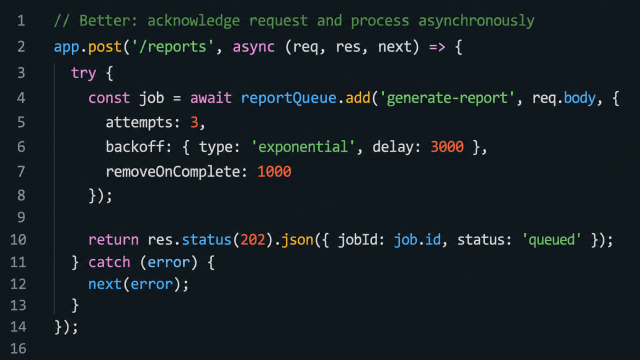
| Production recommendation Keep HTTP handlers focused on validation, authorization, orchestration, and fast I/O. Move CPU-intensive or long-running workloads to Worker Threads, background workers, or dedicated services. |
Unbounded Asynchronous Concurrency
Asynchronous programming does not mean unlimited scalability. Promise.all() is useful when a small number of independent operations can safely run in parallel, but launching thousands of operations at once can overwhelm application memory, MongoDB connection pools, Redis, or external APIs.
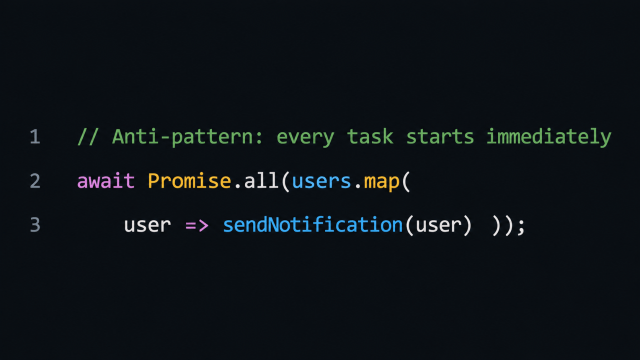
This can lead to increased heap usage, garbage collection pressure, downstream throttling, and unstable response times. These are classic Node.js production issues that appear only under real traffic and rarely show up in staging.
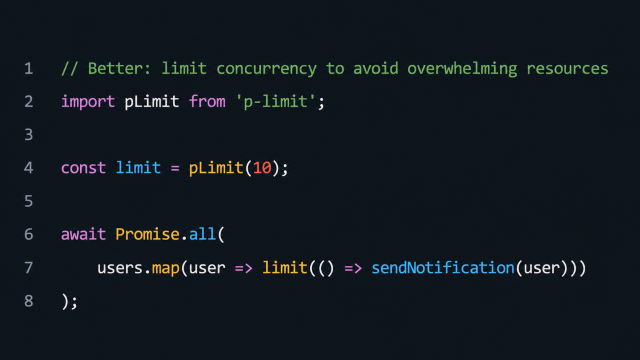
| Execution Model | Benefit | Risk |
| Sequential await | Predictable resource usage | Slow for independent operations |
| Unlimited Promise. all | Maximum parallelism | Memory pressure and downstream overload |
| Bounded concurrency | Balanced throughput | Requires tuning and monitoring |
Database Round Trips and N+1 Queries
For many Node.js APIs, database access dominates request latency. The problem is not always that an individual query is slow; it is often that a single API request performs too many queries. Each database call introduces network latency, connection acquisition time, serialization overhead, and additional load on the database server.
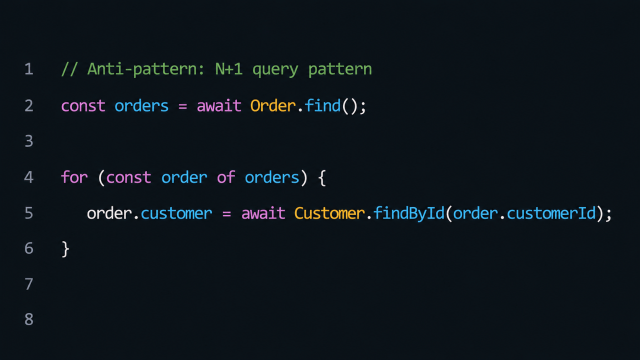
This pattern may look harmless with ten records, but it scales poorly with hundreds or thousands. Prefer batching, aggregation, projection, and pagination.
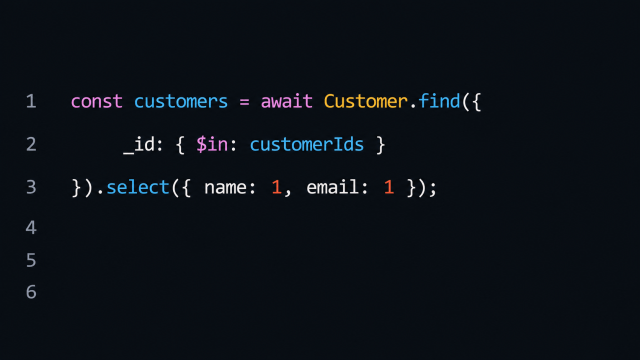
In MongoDB applications, consider aggregation pipelines with $lookup when the access pattern requires related data, but also evaluate whether denormalization would better match read-heavy workloads.
Missing Indexes and Query Planner Blind Spots
Queries that are fast on small collections can become expensive as data grows. If MongoDB cannot use a suitable index, it may perform a collection scan, examining many documents to return a small result set. Index design should be based on real query patterns, not guesswork.
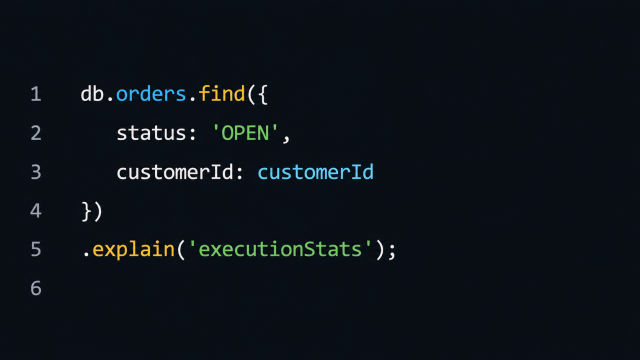
| Execution Stage | Meaning |
| IXSCAN | MongoDB uses an index to locate matching keys. |
| FETCH | MongoDB retrieves documents referenced by index entries. |
| COLLSCAN | MongoDB scans documents in the collection; investigate for large datasets. |
Use explain(“executionStats”) to review executionTimeMillis, totalDocsExamined, totalKeysExamined, and the winning plan. A good index often reduces documents examined, improves sorting performance, and reduces database CPU usage. However, indexes also increase write overhead and storage usage, so unused indexes should be reviewed and removed.
Memory Management and Garbage Collection
Production Node.js services are long-running processes. Memory that is unintentionally retained grows over time, increasing garbage collection activity and eventually causing process restarts or out-of-memory failures. Memory leaks are usually caused by retained references, not by the garbage collector itself.
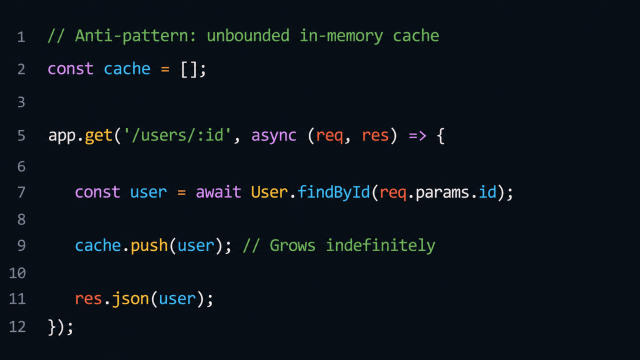
Common leak sources include global arrays or maps, unbounded caches, repeated Event Emitter listeners, timers, and closures retaining large objects. This is one of the most frequent Node.js production problems and a common source of memory leak incidents. Use bounded caches and TTL-based eviction when data must remain in memory.
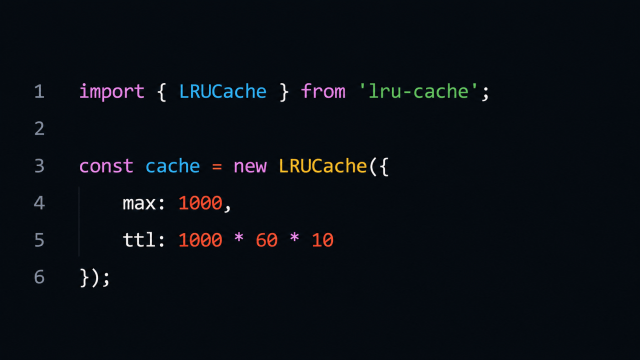
| Monitoring guidance Track heap utilization, RSS memory, garbage collection duration, event loop delay, and container restarts. A steadily increasing memory baseline is a strong signal for investigation. |
Streams vs Buffers for Large Payloads
Reading entire files or payloads into memory is a common source of memory pressure. Buffers are useful for small binary payloads, but large exports, uploads, downloads, and log processing should use streams so data is processed incrementally.
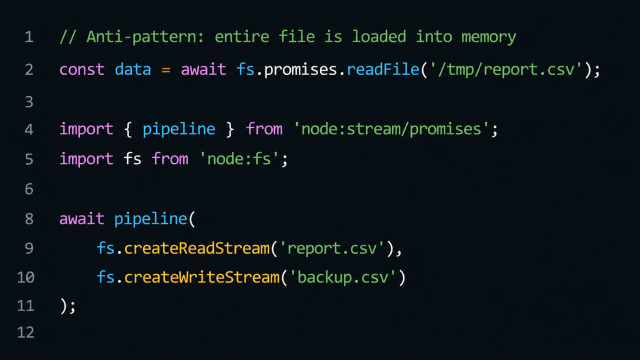
Streams support backpressure, which prevents a fast producer from overwhelming a slower consumer. Use stream.pipeline() instead of manual piping for reliable error propagation and resource cleanup.
Background Processing with BullMQ and Worker Threads
Long-running operations should not block HTTP response delivery. Background processing keeps APIs responsive while workers handle report generation, imports, notifications, image processing, and synchronization jobs.
| Approach | Best For | Consideration |
| Worker Threads | CPU-heavy JavaScript | Requires message passing and lifecycle management |
| BullMQ | Async business workflows | Requires Redis and worker observability |
| Child Processes | External executables | More isolation, higher overhead |
| Dedicated Worker Service | Large distributed workloads | More operational complexity |

Design jobs to be idempotent because retries, worker restarts, and network failures can cause duplicate execution. Store job identifiers and business operation keys so repeated processing does not create duplicate invoices, payments, or notifications.
Resilience: Timeouts, Retries, Circuit Breakers, and Idempotency
Production APIs depend on databases, authentication providers, payment gateways, object storage, email services, and third-party integrations. These systems can become slow or unavailable. Resilient Node.js services limit the blast radius of dependency failures. The communication protocol between services also plays a role in resilience and performance — see our breakdown of gRPC vs REST and Protocol Buffers for a deeper comparison.
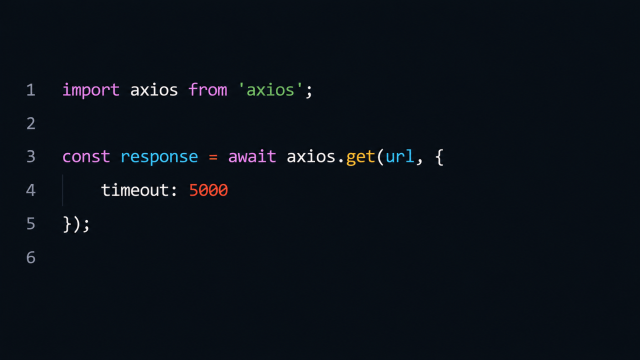
Timeouts prevent indefinite waiting. Retries should be used only for transient failures and should include exponential backoff with jitter to avoid retry storms. Circuit breakers prevent repeated calls to a dependency that is already failing, allowing the system to fail fast or return a fallback response.
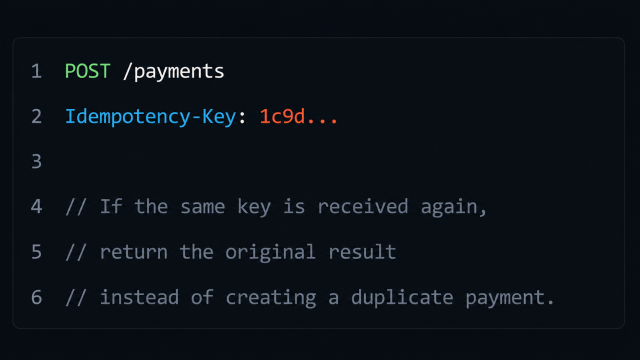
Idempotency is essential wherever retries are possible, especially for payments, order creation, inventory updates, and notification workflows.
Caching Done Right
Caching can significantly reduce latency and database load, but incorrect caching can serve stale or inconsistent data. Cache only data that is frequently read, expensive to compute or retrieve, and safe to serve with temporary staleness.
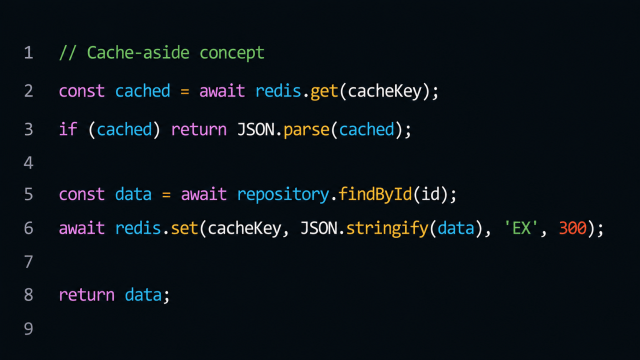
Good cache keys should be predictable and scoped, for example, user:123:profile:v2. TTL values should reflect business requirements. Too short a TTL reduces cache effectiveness, while too long a TTL increases stale data risk. Prevent cache stampedes using request coalescing, distributed locks, or proactive refresh strategies for hot keys.
Observability and Production Readiness
Node.js production problems are difficult to diagnose without proper telemetry, especially as applications scale. A production Node.js API should emit structured logs, metrics, and traces. Monitoring only CPU and memory is not enough.
| Signal | What to Track |
| Latency | P50, P95, P99 per endpoint |
| Runtime | Event loop delay, heap usage, GC duration |
| Database | Query duration, pool usage, slow queries, collection scans |
| Queues | Queue depth, failed jobs, retry count, processing time |
| Dependencies | Timeouts, error rate, circuit breaker state |
Structured logs should include requestId, userId where appropriate, endpoint, status code, latency, and error details. Distributed tracing with OpenTelemetry helps teams understand request flow across services and identify bottlenecks in complex systems.
Production Readiness Checklist
- Don’t do any CPU-intensive synchronous work in request handlers.
- Workers or queues are used to handle long-running operations.
- Bulk operations can run only one at a time.
- Database queries are batched where possible.
- Indexes have been reviewed for paths that are queried often.
- When large collections are paginated and projected…
- Large files are processed using streams.
- Caches have TTLs, rules for invalidation, and monitoring.
- Explicit timeouts on outgoing requests.
- Retries use exponential backoff with jitter.
- Idempotency is used for retryable business operations.
- Enable structured logging and correlation IDs
- Node.js monitoring and error tracking of P95/P99 latency, event loop delay, heap usage, and queue depth
- Deployments and container restarts are gracefully shut down.
- Load tests are representative of real traffic and data mass.
Conclusion
Node.js performance issues don’t come all at once. Usually, they start as small inefficiencies that are only visible when concurrency, data volume, and dependency complexity increase. Most improvements come from strong high-performance backend architecture : short request paths, fewer database round-trips, limiting concurrency, streaming large data, offloading long-running work, and a focus on observability.
A production-grade Node.js API doesn’t only perform well under normal traffic. It is predictable under load, gracefully fails when dependencies degrade, and exposes sufficient telemetry such that teams can easily identify problems. By considering performance, resilience, observability as design concerns from the start, and following Node.js best practices for production, engineering teams can build APIs that scale with confidence.
You can contact Ahex Technologies to hire Node.js developers for backend optimization, Node.js architecture review, audit, development, production support services, and more.
Frequently Asked Questions
Q1. What is Node.js and why is it used?
Node.js is an open-source JavaScript runtime that is built on Chrome’s V8 engine. It enables developers to build fast and scalable server-side applications. Node.js is widely used for developing APIs, real-time applications, microservices, and data-intensive web applications.
Q2. What is event loop blocking in Node.js?
Event loop blocking is a severe problem that occurs when CPU-intensive synchronous operations prevent the Node.js event loop from processing other incoming requests. This results in an increase in response times and significantly reduces throughput. It also makes APIs slow or unresponsive under heavy load.
Q3. What are the top Node.js production problems that affect API performance?
Common Node.js production problems include event loop blocking, memory leaks, unbounded asynchronous concurrency, inefficient database queries, missing indexes, improper caching, and inadequate monitoring. These issues often result in high latency, increased resource usage, and reduced API reliability.
Q4. What are the causes of Node.js memory leak incidents?
There can be many root causes of Node.js memory leak incidents. The common causes are unbounded caches, global variables, retained object references, EventEmitter listener leaks, timers, and closures holding large objects.
Q5. What are the best practices to tackle Node.js production problems?
There are best practices that you can follow to tackle issues in Node.js production. These are
- Avoid CPU-intensive work in request handlers
- Use Worker Threads or queues for background tasks
- Optimize database queries and indexes
- Implementing caching
- Monitor application health
- Configure timeouts, retries, and structured logging.
Q6. How can I ensure API performance when built using Node.js?
To ensure API performance, regularly monitor and identify issues and fix them before they affect performance. You can contact Ahex Technologies for an in-depth expert-level Node.js production and architecture audit.