Why MSMEs Struggle with Digital Transformation
If you talk to any MSME (Micro, Small, and Medium Enterprise) owner in India, there’s a story you’ll hear over and over again:
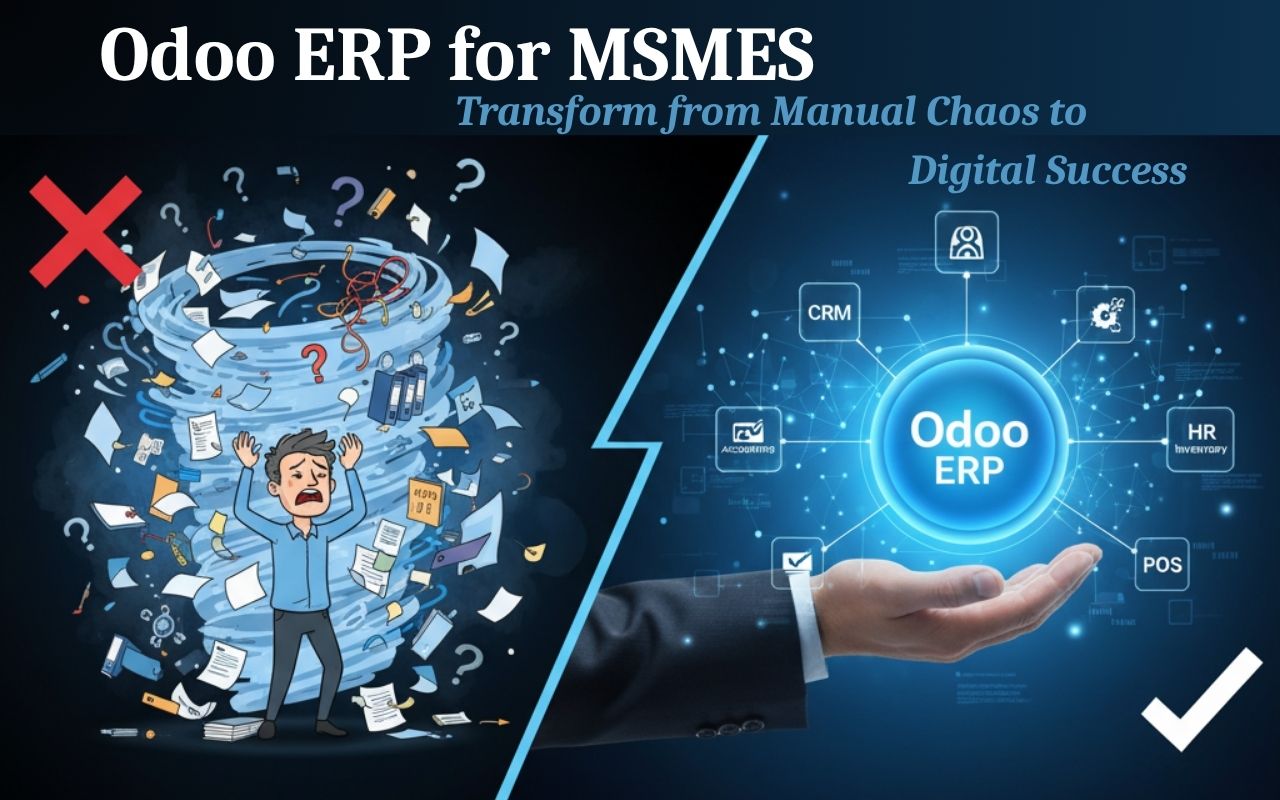
“We started with one small software for billing… then added something for inventory… then a CRM for sales tracking… then payroll software… then a separate helpdesk. Now, everything is everywhere, and nothing talks to each other!”
And this is not an exaggeration. In the early growth stages, MSMEs are extremely cost-conscious. Budgets are tight, and they often choose vertical-specific software to solve the most urgent problem maybe invoicing, or managing a sales pipeline, or keeping inventory in check.
But over time, this “patchwork” of tools creates chaos:
- Data silos — information stays stuck in one department’s software and never flows to others.
- Extra costs — paying for multiple licenses, integrations, and training.
- Decision delays — leaders can’t see real-time, consolidated business data.
- Employee fatigue — switching between multiple interfaces is a nightmare.
And yet, digital transformation is not optional anymore it’s a survival need.
This is where Odoo ERP changes the game for MSMEs. Odoo isn’t just software it’s a complete business engine that integrates your entire organisation: sales, marketing, CRM, procurement, HR, accounting, projects, support all in one platform. And, importantly for MSMEs, it’s affordable with a fast ROI.
The Real Problem: MSMEs’ Digital Journey Gone Wrong
Most MSMEs in India have historically equated ERP with accounting software something for finance teams to file GST returns, reconcile bank accounts, and track expenses.
Sometimes, they have a separate CRM for sales, but that’s about it.
Here’s what typically happens:
- Initial Stage – They start with one critical tool (like Tally for accounting, or Zoho for CRM).
- Growth Stage – As business grows, they add industry-specific tools for inventory, payroll, helpdesk, project management, etc.
- Fragmentation Stage – Multiple tools are in place, but data is scattered, reporting is manual, and decision-making suffers.
- Firefighting Stage – They start spending more on integrations, maintenance, and training — ironically, costs go up instead of down.
It’s like building a house by buying different parts from different vendors without ever checking if they fit together sooner or later, the cracks show.
The Odoo ERP Advantage for MSMEs
Odoo ERP turns that chaotic scenario into a centralised, efficient, cost-effective ecosystem.
Instead of 10 different tools, you get one integrated platform that covers all business needs.
Key Benefits Odoo ERP Software
- Single Source of Truth
All departments like sales, finance, HR, operations work on the same database. No duplicate data entry, no data mismatches. - Scalable as You Grow
Start with the Odoo ERP modules like you need now (Odoo CRM + Odoo Accounting) and add other modules later (like Odoo HR, Odoo Helpdesk, or Odoo Manufacturing). - Cost-Effective
One vendor, one platform no expensive multi-software integrations. - Industry Agnostic but Customisable
Whether you’re in manufacturing, retail, services, distribution, or e-commerce, Odoo adapts to your processes. - Fast ROI
Savings from reduced duplication, fewer licenses, and faster operations often outweigh the subscription cost in months.
Odoo Modules That Transform MSMEs
Let’s break down how Odoo covers every major function an MSME needs and why it’s better than juggling multiple standalone apps.
| Business Function | Traditional Approach | Odoo Approach |
| Accounting & Finance | Tally, QuickBooks, Zoho Books separate from sales data | Fully integrated accounting with CRM, inventory, expenses |
| Sales & CRM | Zoho CRM, Salesforce (too costly for MSMEs) | Built-in CRM with lead tracking, opportunity management, and automated follow-ups |
| Inventory | Industry-specific inventory software | Integrated with sales, purchases, and manufacturing |
| HR & Payroll | Excel sheets or separate HRMS tool | Employee records, payroll, leaves, expenses in one place |
| Project Management | Trello, Asana separate from ERP | Resource planning, task tracking, timesheets integrated with finance |
| Helpdesk | Freshdesk or Zendesk (extra cost) | Native helpdesk linked to CRM and knowledge base |
| Marketing | Mailchimp, separate SMS/email tools | Odoo Email Marketing, SMS, and Social Marketing in one |
Real-World MSME Example
Before Odoo:
A Beverage distributor in Hyderabad, India used:
- Tally for accounts
- Zoho CRM for sales
- Excel for inventory
- Freshdesk for support
Every time a sales order came in, the sales team emailed accounts, who then entered the order in Tally. Inventory updates were manual and often incorrect. Support tickets didn’t link back to customer purchase history.
After Odoo ERP Integration
- Sales entered orders directly in Odoo accounts saw them instantly.
- Inventory updated in real time.
- Support team could see the customer’s purchase history instantly.
- CEO had a single dashboard showing sales, receivables, and stock.
The Cost Question: Is Odoo Really Affordable for MSMEs?
Absolutely, Most MSMEs spend more than they realise when using multiple tools. With Odoo, MSMEs can start small (even with a free app) and scale to Odoo Enterprise with other apps as they grow still spending less than maintaining 6-7 different tools.
Why Early and Excessive Customization is a Trap
One common mistake MSMEs make during ERP adoption:
Customizing too much, too soon.
- Early customisation without fully understanding the standard Odoo features leads to complexity.
- Over-customisation increases upgrade costs and makes future scaling difficult.
Best Practice:
- Start with Odoo’s out-of-the-box workflows.
- Train your team on standard features.
- Customise only where it adds real business value.
Steps to Move from Chaos to Digital Success with Odoo ERP
- Audit Your Current Software Stack
List all tools, their costs, and how data flows between them. - Define Core Business Needs
Don’t try to solve everything in Phase 1. Start with your biggest pain points. - Choose the Right Odoo Partner
A good Odoo implementation partner helps you configure before customizing. - Train Your Teams
Technology works only if people know how to use it. - Go Live in Phases
Don’t move everything in one go migrate department by department.
Conclusion: From Manual to Magical
MSMEs often see ERP as something “big companies” do. But with Odoo ERP, that’s no longer true.
You can start small, scale big, and keep costs in check while giving your teams a single, powerful platform that connects sales, finance, HR, projects, and support.
The shift from manual chaos to digital success isn’t just about tools it’s about having a unified, real-time view of your business so you can make smarter, faster decisions.
If you’re tired of juggling multiple tools and want a cost-effective ERP with real ROI, Odoo ERP is the bridge between where you are and where you want to be.