
How NLP Is Reshaping Clinical Documentation and Medical Coding
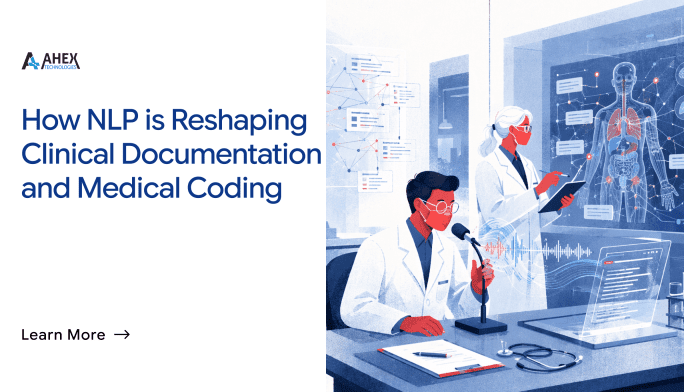
Sit in on a typical outpatient visit and you will notice something odd.
The patient talks. The doctor listens briefly, then turns to the screen. Typing starts. Clicking follows. The interaction feels split, as if attention is being shared between two priorities that do not quite coexist.
This is not about poor bedside manner. It is a side effect of how modern healthcare operates. Documentation has grown into a heavy, unavoidable layer and it is pulling clinicians away from the very thing they are trained to do.
Natural Language Processing, or NLP, is starting to change that. Not overnight, and not perfectly. But in ways that are already noticeable if you know where to look.
The Quiet Cost of Documentation
In practice, documentation is not just a task. It becomes a time sink.
A large portion of a physician’s day goes into entering structured data, writing notes, and navigating EHR interfaces. The real issue is not only the time spent during clinic hours. It is what happens after.
Notes pile up. Work spills into evenings. Pajama time has become part of the workflow, not the exception.
What this really means is that cognitive energy, which is arguably a clinician’s most valuable resource, is being spent on clerical work. That has downstream effects. Decision fatigue increases. Consults slow down. Attention drops where it matters most.
Using NLP in Clinical Documentation: Turning Messy Notes Into Usable Data
Clinical notes are not written for machines. They are fast, shorthand-heavy, and often incomplete in a grammatical sense.
That is where the NLP pipeline comes in.
At a basic level, it breaks text into manageable pieces such as sentences, tokens, and normalized terms. The real value shows up in how it handles context.
Take a simple line: Patient denies chest pain. A keyword-based system flags chest pain and moves on. An NLP system pauses, interprets, and understands the negation.
That distinction sounds small, but it is not.
Extracting What Actually Matters
Once the text is processed, the next challenge is identifying what is important.
Named Entity Recognition, or NER, pulls out structured elements such as symptoms, diagnoses, medications, and dosages from unstructured notes.
In reality, this becomes tricky quickly. Doctors do not write in full sentences. They rely on abbreviations, shortcuts, and personal styles.
Pt c/o SOB, hx HTN.
To someone outside healthcare, that is barely readable. To a trained model, it is clear: the patient complains of shortness of breath and has a history of hypertension.
One thing that often gets overlooked here is consistency. NER does not just extract data. It standardizes it, which is what makes downstream automation possible. This is one of the core reasons generative AI is finding significant traction in healthcare, where data quality directly affects patient outcomes.
Coding Is Still Human, Just Faster
Medical coding has always been detail-heavy. Small differences in wording can lead to entirely different codes and billing outcomes.
Machine learning models now assist by suggesting ICD-10 and CPT codes based on extracted clinical data.
They are not replacing coders. That is neither realistic nor desirable.
Instead, they reduce the search space. Coders start with a strong suggestion rather than a blank slate. This speeds up the process and reduces the kind of errors that lead to claim rejections.
When the Keyboard Disappears
This is where things start to feel different.
Ambient clinical intelligence systems listen to conversations during consultations and generate notes in real time. There is no typing and no need to switch between screens.
In practice, it is not flawless. Background noise, accents, and overlapping speech still create edge cases. Even with those limitations, the shift is noticeable. This is where speech-to-text capabilities like those explored in how Rev AI is revolutionizing development become particularly relevant. Even with those limitations, the shift is noticeable.
Doctors stay engaged. Patients feel heard. Documentation happens without becoming the center of attention.
That is a meaningful change.
Why Training Data Makes or Breaks It
There is a tendency to assume language models can simply figure things out. In clinical settings, that assumption does not hold.
Medical language is dense, context-driven, and highly specialized. Models need exposure to large volumes of anonymized clinical notes across specialties to perform reliably. This is a core consideration in LLM model development, where domain-specific training data defines how well a model performs in specialized environments.
A model trained on general text will miss nuance. It may even misinterpret critical information.
This is one of those areas where shortcuts show up immediately in performance.
Accuracy Is a Threshold, Not a Metric
You will often hear terms like precision and recall during evaluation. They matter, but they are not the full picture.
A model can perform well on paper and still fail in real-world use.
That is why clinical validation is critical. Doctors and coders review outputs within real workflows. They test edge cases and ambiguous scenarios. They look for situations where the model hesitates or makes confident mistakes.
If it does not hold up there, it does not get deployed.
The Make-or-Break Factor Is Workflow Fit
Many teams underestimate this. Even a strong model will fail if it disrupts workflow.
Clinicians do not have time to adapt to tools that slow them down. Extra clicks, separate interfaces, or additional logins quickly become barriers.
The systems that work are the ones you barely notice. They integrate directly into existing EHRs and surface outputs where clinicians already work. Building these kinds of seamlessly embedded experiences is where AI-enabled application development plays a decisive role.
Open the chart. Review the suggestion. Move on.
Anything more complicated than that, and adoption drops quickly.
The Business Case That Actually Drives Adoption
At some point, every hospital leadership team asks the same question. Does this move the needle financially, or is it just another technology expense?
The answer depends on execution, but when NLP is implemented well, the impact shows up quickly.
Revenue cycles tighten. Cleaner coding reduces claim denials and rework. That directly improves cash flow, not just on paper but in actual turnaround time.
Operational capacity increases. When physicians spend less time documenting, schedules open up. Even a small increase in patient volume per day compounds over time.
Then there is retention. This is often underestimated. Replacing an experienced physician is expensive and disruptive. Reducing documentation burden improves job satisfaction in a very practical way, and that helps keep teams stable.
What matters here is not theoretical ROI. Hospitals look for measurable outcomes within months, not years. When systems reduce friction without adding complexity, the financial case becomes obvious.
When they do not, adoption stalls regardless of how advanced the technology appears.
Where This Is Headed
NLP is not replacing clinicians. That narrative does not hold up in practice.
What it is doing, when implemented thoughtfully, is removing friction. The kind that builds up over years and quietly reshapes how care is delivered. The general trend toward developing agentic AI is the same as systems that work intelligently in the background so that professionals can focus on higher-level tasks.
There is still work to be done. Accuracy needs constant tuning. Integration challenges remain. Not every setting will see the same benefits.
But the direction is clear.
Less time documenting. More time thinking. And ideally, more time actually engaging with patients.
That is a shift worth paying attention to.
Ready to Reduce Files Burden in Your Medical Workflows?
It’s time to change things if your team is spending more time on paperwork than on patients. Our AI developers have helped healthcare organizations set up NLP-powered documentation and coding solutions that work seamlessly with their current workflows.
Have a product idea or an existing build that needs to scale? Partner with Ahex and close the gaps before your customers find them.
Book a free consultation


