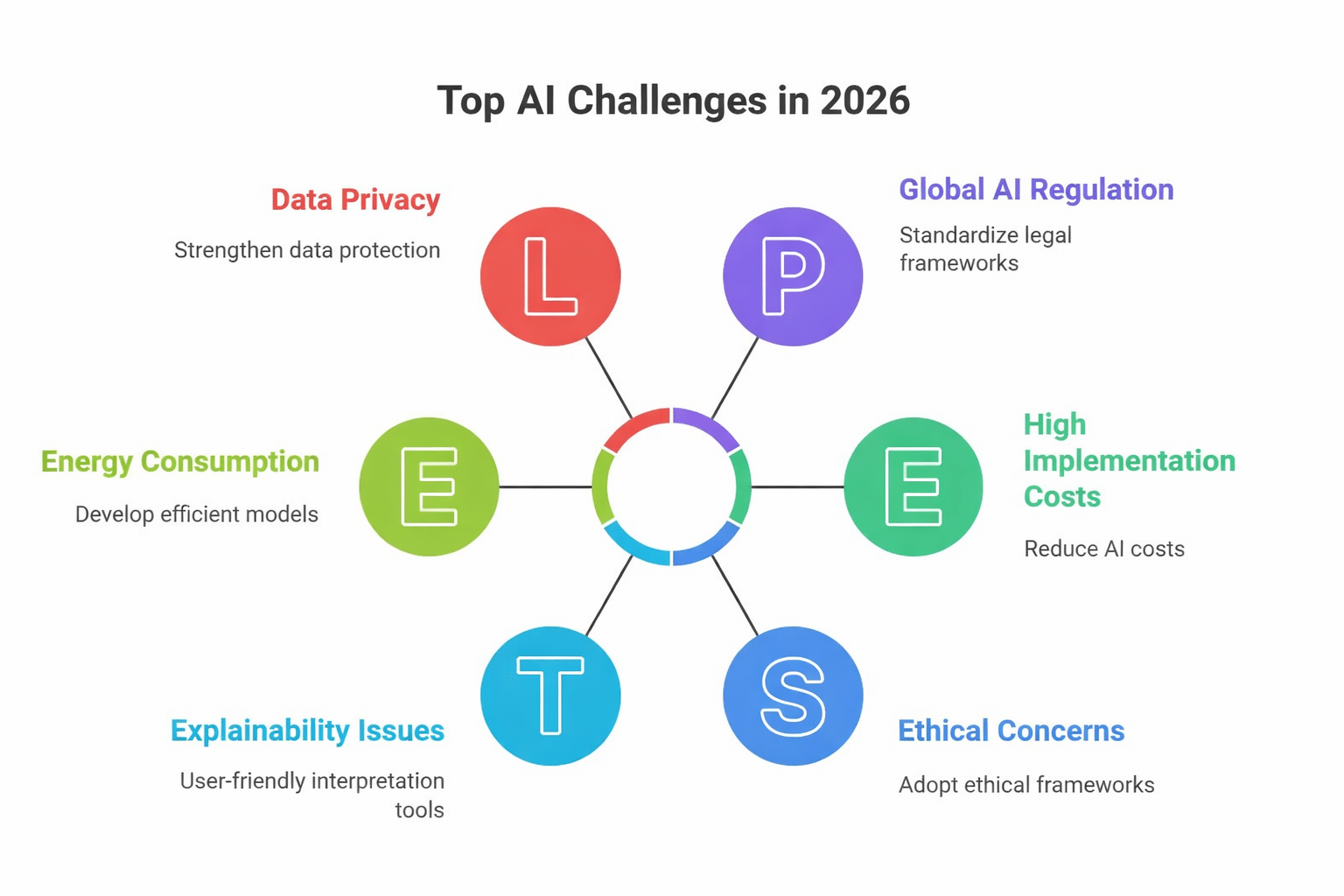
In this blog, we will talk about the most common AI development challenges and the techniques or measures to take to overcome them effectively.
According to McKinsey, approximately 88% of organizations use AI in at least one business function on a regular basis. This shows that in 2026, more businesses have started using artificial intelligence to streamline their operations and digitally transform.

However, many organizations face challenges when leveraging AI development services, which can slow down AI adoption or result in underperforming solutions if not addressed properly.
We have discussed these top challenges in AI development services and the approach to overcoming AI implementation issues. So, let’s start.
Key Challenges in AI Development Services and Best Practices to Overcome Them
So, these are the common AI pitfalls that you are bound to face while developing your AI-powered solutions, apps, software, and others. However, we have also mentioned the best practices that help in overcoming AI implementation issues.
Challenge#1: Data Challenges in AI Development
The most common challenge in AI development is related to the data. AI models, such as GPT, BERT, LLaMA, and others, heavily rely on large volumes of data. These models learn from these datasets to give accurate outputs.
So, if the datasets are incomplete and contain unstructured information, duplicate records, or biased data, it leads to unreliable predictions. Collecting high-quality data takes time, and it is expensive too, especially when manual annotation is required.
Poor data quality makes businesses struggle with effective AI development. Even though they use the most advanced AI algorithms, they fail to deliver expected and accurate results.
Solution
To overcome data challenges in AI development, businesses need to start by implementing strong data governance practices. By following these practices, they can ensure consistent data collection, storage, and management.
To ensure high-quality data, you need to remove errors, duplicates, and inconsistencies from it, using data cleaning and pre-processing tools.
If the high-quality labelled data is limited, you can leverage data annotation services, create synthetic data using generative AI, or transfer learning to reduce the dependency on large datasets.
Lastly, you need to keep monitoring data quality and keep updating it to ensure that your AI models receive accurate and updated information. This would ensure more reliable and precise results.
Challenge#2: Smooth AI Integration in Business
Another challenge that most businesses face is the integration of artificial intelligence in business systems. Experts say that integrating AI into existing business systems is often more challenging than building the model itself.
In 2026, there are many organizations that still rely on legacy software, outdated infrastructure, or fragmented data sources that are not compatible with modern AI solutions.
Result of this? It leads to issues in data flow, API connectivity, and real-time processing.
Solution
To tackle this challenge and ensure smooth AI integration in business, you need to begin with a technology assessment. In this assessment, you will find compatibility gaps between your existing systems and new AI solutions.
You can choose between modular, API-driven architecture or microservices to connect AI components with your legacy software. Moreover, don’t forget to standardize the data formats and build robust data pipelines to ensure a seamless data flow.
For complete integration, you can start small and scale gradually. This way, your operations will not be disrupted, and you will make a smooth transition to AI-driven operations.
Challenge#3. AI Deployment Challenges
AI deployment challenges occur when you deploy custom AI models to real-world production systems. These production systems are different from testing environments, as these involve settings related to live data, higher workloads, and unpredictable user behaviors.
It is very challenging to ensure that AI models perform consistently and accurately under these conditions.
Moreover, there are other AI deployment challenges, such as setting up scalable infrastructure, managing latency, ensuring reliable APIs, and handling hardware or cloud dependencies.
Once you deploy the models, you may experience model drift, as due to changing data patterns, the accuracy declines significantly.
Solution
The solution to tackle AI deployment challenges is you adopt a robust ML Ops (Machine Learning Operations) framework. This automates the deployment and helps you monitor and update your AI models.
Moreover, you can use containerization tools like Docker and Kubernetes to ensure consistent environments across development and production.
Also, you need to monitor the performance of models in real-time to detect various issues. Latency spikes, API failures, and model drift are among these issues.
Lastly, to ensure that your AI models stay updated even when data pattern evolves, you must implement automated retraining pipelines.
Challenge#4. AI Scalability Issues
Among the key AI development challenges is the issue related to AI scalability that arises when AI systems struggle to maintain performance.
AI models work efficiently with small datasets or limited users, but when these data volumes, user load, or processing demands increase, they slow down, provide inaccurate results, and even require excessive computational power.
These AI development challenges are mostly common in real-time AI apps, such as chatbots, fraud detection tools, or recommendation engines.
Solution
Cloud-based infrastructure is the solution to overcome AI scalability issues. It supports auto-scaling and elastic resource allocation when data or user demands grow.
To maintain the performance, you can use distributed computing frameworks that enable AI models to process large datasets efficiently. Also, optimize the models to reduce the computational load without compromising their accuracy.
Moreover, to protect your single system from overloading, you can implement a microservices architecture that ensures different AI components scale independently.
Challenge#5. Ethical AI Development
Ethical AI development is one of the fastest-growing AI development challenges for businesses across the world.
Businesses highly rely on AI to make decisions that impact customers, employees, and society. However, some AI models unintentionally adopt biases from the training data they were provided, which leads to unfair or discriminatory outcomes.
Moreover, many advanced models work in such a way that it becomes difficult to explain how the decisions are made. Also, many times, privacy concerns and the demand for strict compliance are raised when it comes to handling sensitive data.
Solution
To address ethical AI challenges, businesses should begin by establishing clear AI ethics guidelines that define the fair use of AI solutions, transparency, and responsible use of data.
To tackle bias, businesses must conduct bias detection and fairness audits. These audits help in identifying discriminatory partners early in the development patterns. Also, the risk of biased outcomes can be reduced by using diverse and representative datasets to train the models.
To bring transparency in how decisions are made by AI, you must implement explainable AI (XAI) techniques. These make model decisions more transparent and easier to validate.
Lastly, organizations should also follow strict privacy and regulatory standards to secure sensitive data and ensure that it is used the right way.
Challenge#6. AI Project Management
The last entry on the list of AI development challenges is AI Project Management. AI initiatives are highly experimental, data-dependent, and often unpredictable.
These projects involve iterative cycles of data preparation, model training, evaluation, and refinement, making timelines hard to estimate accurately.
Hence, this causes misalignment between business expectations and technical feasibility and then leads to scope creep or unrealistic goals. Another challenge in AI project management is maintaining coordination between multiple teams.
Solution
To manage AI projects effectively, businesses must begin with clear project scoping, defining measurable goals, use cases, data needs, and success metrics before starting the project.
Using agile and iterative development can bring flexibility in a project, and makes it easier for teams to make changes even when models evolve, and new insights emerge. You can also reduce AI project failure risks by developing proof of concepts (PoCs) before full-scale development.
To ensure a successful collaboration, project managers should communicate with data scientists, developers, domain experts, and business stakeholders frequently and share regular sprint reviews and checkpoints.
Conclusion
So, these were the common AI pitfalls that most businesses face when they start or during their custom AI solution development. They struggle with data challenges, smooth AI integration, deployment challenges, scalability issues, ethical AI development, and efficient project management.
However, they are overcoming AI implementation issues effectively by following the AI development best practices that we mentioned under the headings ‘Solution’ for each challenge. These solutions are tried-and-tested and are used by the majority of AI developers worldwide during development and implementation.
In any case, if you are also facing AI development challenges, then contact Ahex Technologies, the best AI development company in India.
We have helped 500+ start ups, SMBs, and enterprises tackle various kinds of AI-related challenges and successfully transformed their operations with custom AI-driven solutions. Contact us now for more details.